
Positions and risk
Understanding trade capacity and position protection
Separate a shared margin budget and estimated contract capacity from position protection, execution risk and the limits of stop orders in Citrine.
In this article
Separate budget, capacity and protection
Three useful numbers or states can sit near one another in a trading workspace and still answer very different questions. Allocation is a budget decision. Estimated capacity concerns how much additional exposure current inputs may support. Protection concerns orders and management for exposure that already exists.
The Citrine product guide describes allocation as a shared margin budget and Edge details as explanations of entry requirements, timers and estimated capacity. A condition marked ready is not a guarantee that an order will be submitted immediately. Likewise, capacity is not a statement that taking all available exposure would be appropriate.
Reading these concepts separately prevents a common reasoning error: "The software says it can fit, so the position must be safe." Affordability under a model and the possibility of a loss are different questions.
Read a capacity estimate in context
An estimate needs inputs. For contract capacity those include funds, product price and margin context, with applicable fees also needing coverage. A balance on its own is not enough to explain an order quantity. A retained display value is useful context, not proof that all inputs are fresh enough for an execution decision.
When an estimate is surprising, start with the surrounding explanation rather than interpreting the number in isolation:
- Which product? BTC and ETH contract quantities are not interchangeable units of exposure.
- Which budget? Read the allocation and available-funds context. A shared margin budget is not a separate full budget for each product.
- Which market state? A closed or restricted market and an eligible open market have different possibilities.
- Which status? Distinguish an input that is still loading or unavailable from a confirmed numeric value. Keep the exact status text if asking for help.
For historical comparisons, margin provenance matters too. Published backtesting methodology uses recorded overnight margin information and, where needed, a prior eligible observation for the same product. That is a simulation assumption, not a guarantee of the margin available for a live order today.
Do not mistake allocated margin for maximum loss
Imagine an intentionally simplified budgeting example: a hypothetical $600 pool has $360 assigned to a shared margin budget. If an imagined contract needed $90 of margin, dividing $360 by $90 gives four before considering fees, other exposure and other requirements. This is arithmetic, not Citrine's sizing formula, an actual contract specification or a recommendation.
The division does not tell you the notional exposure, how far a price can move, what liquidation conditions apply, or what an exit will cost. It also does not mean $360 is a hard cap on losses. Margin supports exposure; it is not a promise about the path that exposure can take.
That distinction is why a capacity number should not be treated as a target. Increasing a budget changes what may fit. It does not improve the quality of the market conditions, make a stop more likely to fill, or remove execution costs. Use the number to understand constraints, not as a reason to maximize exposure.
Distinguish intended protection from active orders
With Complete and eligible trading access, Citrine uses Coinbase-hosted stop-loss and take-profit orders alongside local monitoring and exit management. The security and protection explanation states the limits: rejection, price gaps, insufficient liquidity and exchange issues can prevent intended execution. Stops are not guarantees.
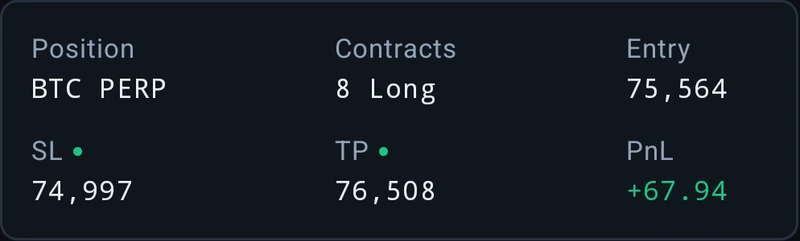
Keep three questions distinct. What protection does the app intend? What order has Coinbase accepted and still shows as active? What local management is currently running? A displayed level answers none of the latter questions by itself.
Accepted exchange-hosted orders are different from phone-dependent monitoring. Exit Citrine stops the local runtime without automatically closing positions or removing exchange orders. Pause holds new entries while eligible live-position management can continue. Observation does not manage protection or perform manual closes.
For an urgent real position, inspect and act through Coinbase directly rather than waiting for a refreshed chart or a support response. Do not repeatedly submit an order action merely because a display is delayed.
Review a position with a short checklist
- Establish actual exposure. Confirm product, direction and quantity, and distinguish a real account position from a simulation.
- Read the current position and protection state. Entry and unrealized PnL provide context; they do not establish an executable exit price or an active protective order.
- Verify exchange orders when there is uncertainty. In particular, check after connectivity trouble, a restart or an interruption.
- Check the managing mode and runtime. An account-monitoring device is not necessarily the execution device.
- Keep new-entry questions separate. Allocation, available funds and capacity govern additional exposure; they do not replace reviewing existing positions.
A good operating review does not need a performance claim. It needs a clear view of what is known, what is estimated, and which component can act. That remains useful whether the current position is gaining, losing or has not yet been opened.
Sources and further reading
Product facts: Citrine product guide, position protection and device responsibilities, and historical margin assumptions. Public handbook: Modes and first-session checklist and safe troubleshooting, reviewed September 29, 2026.
The budgeting example is deliberately incomplete and hypothetical. It is not a current exchange margin quote, a product specification, private implementation detail or a loss estimate.