
Choosing software
Choosing an Android trading bot for Coinbase Advanced futures
Compare account qualification, execution and credential boundaries, built-in versus custom strategies, operating requirements and inspectable costs before choosing Android futures software.
In this article
An Android interface does not tell you where a trading bot executes, who can use its credentials or which futures it supports. Those differences matter more than a long feature list. Start with the job you need the software to do, then ask what evidence would let you check that it does that job.
This guide is published by Citrine Edge, the developer of Citrine. It is a decision framework, not an independent competitor ranking. The same questions apply to Citrine, another product or a system you maintain yourself; choosing no automation is also a valid outcome.
Identify the market before the software
Write down the exchange, account offering, contract and intended direction. Support for Coinbase spot trading is not evidence of support for Coinbase Advanced futures. Coinbase International Exchange perpetual products are not interchangeable with Coinbase Derivatives Exchange (CDE) products. A familiar BTC symbol can hide different contract sizes, margin rules and account requirements.
Confirm your actual derivatives access and the product's supported instruments before paying for software. For U.S. account context, Coinbase's U.S. derivatives guidance describes account qualification and contract context. A bot subscription cannot grant exchange eligibility. Check the contract details rather than assuming one contract means one coin.
Check regional availability and account requirements. Google Play distribution does not grant Coinbase trading access. Canadian access to the supported Coinbase futures is limited to qualified customers under provincial requirements. Residence, an app download or a subscription does not establish product access or the required API permissions.
Map execution, credentials and funds
Ask three separate questions: where do decisions and order requests run, where are credentials stored, and where are trading funds held? A phone can be the execution device or merely a remote control for a hosted service. Neither architecture is automatically the better choice; they create different maintenance and trust obligations.
- On-device execution: inspect power, connectivity, Android background operation and recovery after an interruption. Local credentials still need protection, and supporting services can remain online dependencies.
- Hosted execution: ask who operates the service, how account access is authorized and revoked, and which functions continue if the phone disconnects. Do not infer server reliability from a responsive mobile screen.
- Funds and purchasing: distinguish an exchange balance from a software subscription. Identify any separate custody or transfer requirement instead of treating every payment as a trading deposit.
Citrine runs automation on Android, keeps imported credentials encrypted in app-private storage with Android Keystore-backed protection, and leaves trading funds at Coinbase. Its security guide also identifies network dependencies. Real trading needs View + Trade access; Transfer, Receive and withdrawal permissions are not required. A Trade-enabled credential can still authorize trades, so the absence of withdrawal access is not a promise of harmless account access.
Choose built-in or custom deliberately
A built-in strategy gives you a defined approach to evaluate. A custom strategy environment gives you control over rules, but also makes you responsible for their implementation, testing and ongoing maintenance. An external-signal bridge introduces another component whose delivery, timing and failure behavior you need to understand. These are different jobs, not successive quality grades.
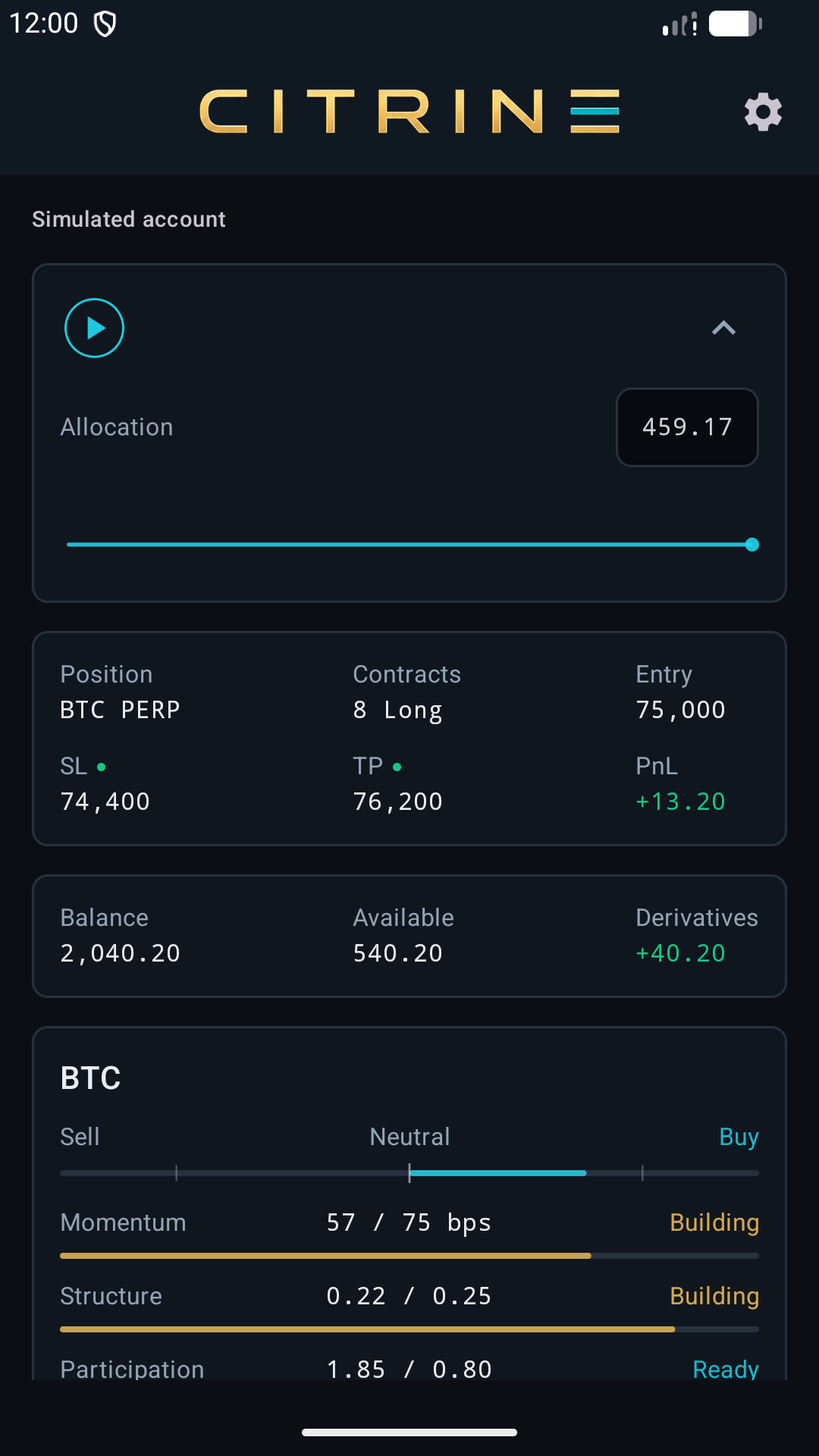
Citrine uses a built-in strategy, not a custom strategy editor or an importer for another platform's system. It evaluates supported BTC and ETH futures within one shared allocation; the current strategy supports BTC buy entries and ETH buy or sell entries. If your requirement is to code arbitrary rules, trade a different instrument set or import an existing strategy, that is a substantive mismatch, not a missing cosmetic feature.
Check the whole operating requirement
Separate evaluation requirements from real-order requirements. Citrine's free Explore includes the Guided Demo, Paper Mode and standard historical backtesting without an API key or subscription. Shadow and Observation need eligible account access. Standard live automation additionally needs Complete, a supported ECDSA key for the Default portfolio with View + Trade permissions, sufficient funds and an eligible Coinbase account.
The device is part of the setup, not just the display. Can you keep it powered and connected, follow background-operation prompts, and check it after updates or restarts? For any product, ask what Pause, Exit and loss of connectivity actually do to existing exposure. In Citrine, Pause holds new entries while eligible management can continue; Exit stops the local runtime without automatically closing positions or canceling exchange orders. Accepted exchange-hosted orders and phone-dependent management are separate responsibilities.
Ask for inspectable costs and decisions
A useful trial should answer questions even if no trade occurs. Can you see why an entry is waiting, where a capacity estimate comes from and which mode owns execution? For simulations, inspect dates, quantities, fee provenance, funding coverage, open exposure and drawdown sampling. A final balance without its basis cannot establish an apples-to-apples comparison.
Compare software charges separately from trading fees, funding and execution costs. Check current purchase and cancellation terms on the pricing page and Google Play rather than assuming a free download includes live automation. The worked bid/ask example shows how identical price movement can produce different hypothetical execution results; the methodology describes Citrine's archive and modeling limits.
Decide whether the responsibility fits
Product fit is not the same as financial suitability. Software that matches your technical requirements does not make leveraged futures appropriate for your circumstances. If you need predictable income, cannot tolerate substantial losses or cannot monitor the operating setup, an automation feature does not resolve that problem. Staying with simulation, retaining manual control or not trading can be the better decision.
Before moving beyond a trial, keep a short decision record:
- Exact task: name the instruments and whether you need built-in rules, custom rules, monitoring or execution.
- Authority: identify the execution device or service, credential permissions, fund location and revocation route.
- Evidence: retain simulation inputs and inspectable details, including unfavorable periods and missing data.
- Operations: explain what happens after a stop or disconnect, and how you reach Coinbase independently.
- Decision: note the unresolved requirement that would make you decline, not just the features that would make you buy.
Sources and a practical next step
Product facts: Citrine reviewer kit, mode comparison and security model. Exchange requirements: official Coinbase U.S. derivatives guidance, consulted October 8, 2026. This article does not assess or rank competitors.
Begin with the ordered free first-session guide and the public handbook's mode and first-session checklist. Judge whether you can explain the controls and assumptions before deciding whether account-connected use serves your purpose.